
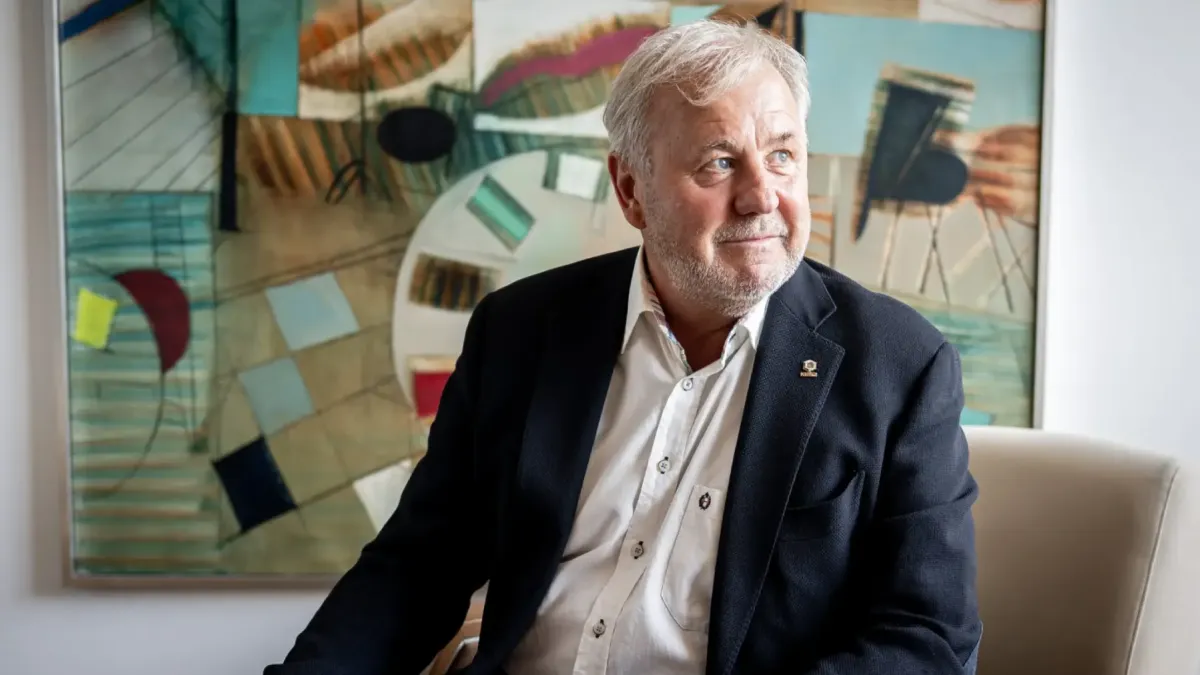
Hungarian construction billionaire: They wanted to discuss things in cigar rooms instead of focusing on performance, but I’m too honest for that kind of game - An Interview with Mihály Varga
Forbes conducted an in-depth interview with Mihály Varga about his entrepreneurial career, the growth of KÉSZ Group, and the current challenges facing the construction industry.
“I’ve been building this corporate group for nearly 45 years, and it’s difficult to plan when you always have to adapt to the fluctuations of the current political environment,” says Mihály Varga, founder of KÉSZ Group. With an estimated value of 102 billion forints, the construction holding company ranked 10th on Forbes’ family wealth list is on the verge of a major transformation, as the founder believes the time has come to pass the baton. In addition to the identity of the new CEO, the conversation also touched on wealth tax, political maneuvering, canceled public procurement contracts, guest workers, and the reconstruction of Ukraine.
Forbes.hu: How is KÉSZ Group different today compared to 2010?
Mihály Varga: I founded KÉSZ Group back in 1982, right after I graduated, and it has undergone continuous evolutionary development ever since. By 2010, we were already a major construction company, but this growth was by no means uninterrupted.
We started 2010 with high hopes; we thought the construction industry was entering a new era. Then, in 2014, we suffered our first major setback. Our bid for the public procurement project for the laser center in Szeged was invalidated. The court later ruled that we had been unlawfully excluded, but by then the winning consortium had already built the center.
I experienced it as a crisis, as if I had lost a close relative.
The competition lasted more than a year, and we had to meet a huge number of requirements; moreover, as a native of Szeged, it was especially painful that we were ultimately left out of it.
How did you manage to get through this situation?
By not giving up despite the disappointment, but from that point on, we tried to protect ourselves much more consciously. Earlier, I hadn’t even suggested that we submit a bid for the renovation of Kossuth Square. By then, word was already out that the tender’s sure winners had already been decided.
In the end, I said we’d participate after all, but only under two conditions: the tender must be conducted electronically, and a notary public must guarantee the transparency of the process. I believed that if KÉSZ had grown to the point of having its own resources and employing several thousand people, it deserved at least enough respect to be allowed to participate in genuine competition.
It’s like a traffic light: there’s green, yellow, and red. If they don’t want to let us through, they shouldn’t just switch from green to red right away they should give us a heads-up first, saying, “Guys, you don’t belong here.” Preparing a bid like this involves the work of twenty to thirty, sometimes a hundred people, and entails enormous costs.
In the end, we submitted a bid of about 16.5 billion forints; as I recall, the others were over 20 billion forints, so I was certain we would win. What I wasn’t certain of, however, was whether we’d be able to see the project through to completion without any trouble. We succeeded, and the area surrounding Parliament was beautifully renovated.
This project was carried out through fair competition, and it restored my faith that it’s worth participating in tenders again.
Was it only during the Orbán administration that bids were invalidated?
No, looking back, I see that we often fell into the “tolerated” category in the past, if I’m using the old classification: prohibited, tolerated, supported. A good example of this is the Árkád project in Győr. It was a competitive bid, and although we submitted the most competitive bid, we were ultimately not selected. At the time, we felt that the decision was not based solely on professional and business considerations.
We’ve had several instances where we submitted by far the best bid, but in the end, the entire tender was canceled.
Something similar happened at the new campus of Pázmány Péter Catholic University. In the 110-billion-forint public procurement process, they submitted a bid that was 11 billion forints cheaper, yet they did not win. What is the current status of the case?
The procedure ultimately ended without a result, but for us, the matter is not yet closed. Our bid was more than 11 billion forints lower, yet it was deemed invalid. Since we did not agree with the contracting authority’s position, we filed an appeal, for which we paid 17.5 million forints.
The adjudication committee did not overturn the decision declaring our bid invalid, but it ruled that the contracting authority had unlawfully restricted our right to inspect documents and, as a result, imposed a fine of 10 million forints on the ministry. Later, the entire public procurement procedure was canceled. We now have only one option left: to assert our rights through legal channels.
I had the feeling that even before the elections, they wanted to push the process to the point of no return.
The past sixteen years have truly been a rigorous training regimen. I often say: we have to cry during training so that we can laugh during the game. I hope our time to play will come someday.
Besides the Szeged laser center mentioned earlier, what was your most memorable struggle?
We tried for three years to be included in the Hungarian National Bank’s bond program. Finally, on our own initiative and at our own expense, we had the corporate group rated by international agencies recognized by the MNB we achieved the highest rating in the Hungarian construction sector at the time thereby proving that we met the necessary criteria. It was very difficult to open this door, but it reinforced my belief that it’s worth making the case based on our performance.
How significant a turning point was it for the construction industry when Viktor Orbán and Lajos Simicska parted ways in 2015?
It was an important turning point, but it didn’t take the construction industry in the direction we had hoped for. I always thought that the Simicska era would have to end someday, because it couldn’t work that way in the long run. What I didn’t expect, however, was what would come next.
At first, while new players were emerging and the Mészáros-led faction was taking shape, we still had hope. When it came to investments by international companies, we were initially still able to compete in a normal market environment such as with the Mercedes plant in Kecskemét or several investments from the Far East. After a while, however, even that window began to close. Wherever public funds entered the system, the path forward was often predetermined.
What was the most striking consequence of this for KÉSZ?
Even though we had the necessary knowledge and capacity, we didn’t even have a chance to participate as the general contractor on several major projects. We prepared a feasibility study in advance for the construction of the Puskás Arena, which we sent to every influential decision-maker, indicating that we were ready for the task.
In the end, we weren’t even given a chance to serve as the general contractor, so we began lobbying with the argument that, since we had gone so far ahead in the planning, you might be bringing in the king, but we’d like to be the ones to place the crown on his head. That’s exactly what happened, because we built the stadium’s entire steel structure as a subcontractor.
The same thing happened with several other major projects. We had the expertise to carry out the entire project, yet we were often only allowed to take on sub-tasks. After a while, you just knew who was leading the charge and how far our role could extend there was no point in pushing any further.
So from KÉSZ’s perspective, was that the reason you remained in the “tolerated” category?
Probably so. They may have needed major Hungarian companies to demonstrate that even players outside the system were given opportunities; they may have needed us as a seal of approval. Fundamentally, the biggest problem of the past 16 years is that society’s morale has been severely undermined. It will be very difficult to restore that.
Often, it wasn’t performance or knowledge that mattered, but social capital; they wanted to discuss things in cigar lounges. I, however, am too honest to take part in such games.
In Romania, for example, we won the contract to build the research center at the Technical University of Cluj-Napoca through genuine competition. This proved to us that, under open and predictable conditions, the KÉSZ Group is competitive even in an international environment, whereas we were unable to participate in the construction of Sapientia’s new facility, even though we submitted the best bids.
According to G7’s data, in 2024, KÉSZ Group was the only company among Hungary’s largest firms that could not be classified as pro-government. What kind of restructuring can be expected among large corporations?
The current situation is certainly unsustainable in the long term, but the restructuring must be carried out with great care. I am confident that the financial sector and decision-makers will be able to distinguish between companies that have built genuine market performance, knowledge, and capabilities, and those that have grown primarily thanks to their political connections. KÉSZ has remained a genuine market player.
We’re in a difficult situation because there isn’t enough work, yet we have to maintain an organization of this size. And maintaining our capabilities costs a great deal of money and energy.
KÉSZ has a very broad portfolio; we possess expertise in design, manufacturing, technology, and construction, which is a huge advantage when carrying out large-scale projects, but also a challenge during a period of crisis. We are hopeful that some kind of recovery will begin in the fall, but we expect the coming year to remain difficult.
When considering this restructuring, it’s also important to recognize that a significant portion of the projects awarded to large, government-affiliated companies is carried out by a long chain of subcontractors, manufacturers, and specialists. If these companies are forced out of business overnight, it could have serious consequences for the entire Hungarian construction industry.
I hope that, with a two-thirds majority, we can pass laws that prevent abuses, because fair competition is essential. I’ve been building this corporate group for nearly 45 years, and it’s difficult to plan when you constantly have to adapt to the ups and downs of the current political climate.
You mentioned that there isn’t enough work for everyone; I suppose that’s why you also have a presence abroad, for example in Ukraine. What is it like to maintain a factory in a country at war?
It’s extremely difficult. Seeing the situation of our colleagues in Ukraine, it was particularly hard to witness the Orbán government’s stance toward Ukraine. I felt ashamed in front of my colleagues. Unfortunately, there have been casualties among our staff as well; two of them died on the front lines. Despite this, we continued our work.
From the very first moment of the war, we tried to help. We made our hotel in Kecskemét available, and colleagues and their family members came to stay there. Even today, they live in conditions where drones strike their homes; they send us the footage, show us what happened, and then go to work the very next day as if nothing had happened.
Has the idea of withdrawing from Ukraine because of the war ever come up?
No. We have direct resources in Ukraine; we’ve been present in the country for more than twenty years. We were drawn there by gas stations; later came the retail stores, followed by warehouses, logistics centers, and factories. We believe there will continue to be significant opportunities in Ukraine in the future. Engineering work is ongoing even now; we won’t leave our employees on their own even during the war.
When this disgrace had been going on for two years, it occurred to me that, given the Hungarian-Ukrainian political situation, it might offer the company greater security if it continued to operate under Polish ownership. My Ukrainian colleagues, however, said it would be a rare occurrence for anyone to stay under such circumstances. That finally convinced me that we had to stay.
To what extent can a Hungarian company be competitive in Ukraine’s reconstruction efforts?
I’d be happy if we were already at that stage.
In a lecture at CEU, the former Ukrainian Minister of Economic Development spoke about how reconstruction is, in fact, already underway in Ukraine, since what is destroyed must be continuously rebuilt.
This is indeed the case. For example, a factory we built was hit by a drone attack, and we’re now planning to repair the damaged sections. We’re also supplying precast reinforced concrete elements for the reconstruction of destroyed bridges. In other words, reconstruction is, in a sense, already underway, even in the midst of the war. We have a huge advantage in Ukraine because we won’t be arriving just as reconstruction begins we’ve been there for twenty years already.
Among KÉSZ Group’s international investments, the reconstruction of Nagorno-Karabakh in Azerbaijan is an interesting example. How did this opportunity arise?
First of all, I would like to clarify that KÉSZ is not participating as an investor in the reconstruction of Azerbaijani Nagorno-Karabakh. The group has previously participated in the implementation of a private investment project in Azerbaijan, and in addition, some of our engineering colleagues have been involved in the implementation of several Azerbaijani projects over the past decades before joining our group. Our local knowledge and experience were therefore already in place.
In early 2022, the Hungarian Ministry of Foreign Affairs announced in the domestic press that it wanted to encourage as many Hungarian companies as possible to participate in the reconstruction of Nagorno-Karabakh. Following this, we began to refocus on opportunities in the Azerbaijani market and certain countries in the neighboring Central Asian region, but we will not, after all, be building a school in Azerbaijan.
Was there going to be a school construction project?
The possibility of a school construction project did come up earlier, but I have no current information on its status.
So were these investments you mentioned also linked to the government?
You’ll have to ask the relevant ministries about that. KÉSZ Group has no ties to Hungarian government clients in connection with its activities in Azerbaijan.
Returning to the question of what to expect after the Orbán regime, what is your opinion on Tisza’s announcement of a ban on guest workers?
I agree that we should rely primarily on the domestic workforce available to us everyone should make do with what they have. But in order to truly reduce our reliance on foreign workers, we need to provide people here at home with adequate training, jobs, and a predictable future.
Isn’t there a labor shortage in the construction industry?
Not so much right now, because there isn’t enough work, but that could easily change if investment picks up again. I’d rather approach the problem from the perspective of why villages are being depopulated. If we can create jobs locally and employ people right here, then it will make sense to train carpenters, joiners, or other skilled workers.
That’s why we’ve tried to focus on helping students develop a love for our trades. We teach them, and when they graduate, they come to work for us in our factories. More than 400 students and more than 400 adults are participating in our training programs in Szeged and Kecskemét. We’ve been involved in vocational education for more than ten years, but today we’ve reached the point where we’re participating in the entire training process.
Tisza Party’s economic plans include a wealth tax. What is your opinion on this, given that you’ve been on the list of Hungary’s wealthiest people for years?
We’ll have to cross that bridge when we get there. I’m basically in favor of it, but the question is how they’ll go about it. Let’s consider my situation: a significant portion of my wealth is tied up in my business it’s not money I can spend freely.
The fortunes and profits of a business fluctuate, especially in a market like the construction industry. In such cases, how is one supposed to pay the wealth tax? By selling a stake in the company?
I think we also need to look at where wealth comes from. I’ve been on the list of the wealthy from the very beginning, but I haven’t progressed much I’ve remained at that level. My wife noticed that I was on one of these lists; she gave me the publication, and I was glad because at least someone had done the math for us. I believe that if someone has been able to achieve above-average results through additional opportunities, then that should come with some additional responsibility. If the law is passed, I’ll comply with it.
You’ve mentioned several times that there isn’t enough work. The annual report shows that your revenue declined last year and that you consolidated several subsidiaries. Is this simply a matter of streamlining, or are you preparing to operate in a much more challenging market environment?
Both. We need to prepare for operating in a more challenging and much more competitive market environment in the coming period, but the restructuring is not simply about cutting costs. It was a deliberate strategic decision to create a new structure in the technical sector and to organize the affected companies into the KÉSZ Industrial Technologies group.
Cooperation among these companies has always been crucial, but now we are reducing overlaps and streamlining operations so that we can provide the same expertise and capabilities more efficiently with fewer managers. The market no longer expects three different companies to submit bids; instead, it expects a single player that possesses all the necessary expertise in a comprehensive manner.
We also need to be prepared to take on more than just individual tasks. That’s how we handled Glencore’s vegetable oil plant, for example. The task there was to produce oil of a specified quality from a specific raw material, and we were responsible for the entire technological solution.
We’ve always tried to stay a step ahead of the market, and we still believe that these steps will allow us to adapt much better to the changing environment. The world has expanded; today we have to compete not only with domestic and European players, but also with Chinese ones, and public procurement contracts won’t just be handed out freely anymore.
Is that why you’re placing increasing emphasis on the energy division alongside the construction group?
Yes, but we don’t view the energy sector as an alternative to construction. Sustainable development has always been one of my top priorities. Today, it’s also a mandatory requirement. We have many international partners, and several of our design firms also work in foreign markets, so sustainability and energy efficiency are fundamental requirements.
A good example of this is our self-developed office building in Szeged, TILIA, which holds the highest sustainability certifications. We have also been voluntarily preparing sustainability reports for several years.
This is one of the reasons we acquired the Greenergy group from an American fund, which includes wind energy, solar energy, and several related sectors. We have already built a 10-megawatt solar power plant near Paks. Meanwhile, a company called GNX was established through a collaboration between my son and a team with a strong professional background in energy and multinational experience. This company primarily focuses on energy storage solutions and has even secured contracts with MOL.
I also see new opportunities in wind energy. As a Hungarian company, it has been difficult to play a meaningful role in this field so far, but now developments can get underway that will allow domestic technical and construction expertise to be integrated. The KÉSZ Group would like to be an active player in this, and we already have some smaller related holdings.
You’ve often spoken about creating a family constitution that could ensure the group’s survival for as long as 300 years. How difficult is it to hand over the leadership of such a large company after several decades, and where does the process stand?
It’s practically impossible. In such a difficult market situation, it wouldn’t be right to simply hand the company over to a successor and leave it up to chance whether they succeed or fail. The handover must take place gradually, in parallel with preparing the next generation.
That’s why, with my children, we started by setting up a startup for each of them, which we support through our asset management firm.
In these ventures, they can explore their interests, learn to grow, build, take on responsibility, and achieve results on their own. If such a venture outgrows itself, it can serve as a foundation for further growth later on.
Meanwhile, at KÉSZ Group, we also need to reach a point where the company’s leaders don’t focus on whether someone has been here for twenty or thirty years, but rather on what they bring to the table. If I can’t make this change, then we won’t be able to renew ourselves.
Are your children open to taking over the company one day?
They’re open to the idea, but since their happiness is what matters most to me, I don’t pressure any of them; instead, we start with independent projects or ventures that match their interests. Some are growing nicely, while for others, growth isn’t necessarily the most important goal. Not all of them are related to the construction industry: we also have projects related to the energy, service, and hygiene sectors.
One of my sons, for example, is studying microbiology; what makes him happy is his research findings being able to publish and feeling that his results have contributed to humanity. We’ll likely support him so that one day he can set up his own laboratory.
My older sons have had the opportunity to gain insight into how the company operates, but I don’t want to force any of them to take over the leadership of the group. They need to find their own paths that’s the most important thing and then we’ll see who will be the next to take the reins after me.
You mentioned that you’ll need to step back. When would you like to hand over day-to-day management?
I am confident that we will select this leader soon, and then a gradual preparation and transition process can begin.
Will it be a family member?
That hasn’t been decided yet, but it’s certainly important that, if an outside leader is chosen, they be able to connect with the family and with the long-term goals set forth in the family constitution. If, later on, the family and I determine that one of my children is prepared for the task based on their interests and achievements, then it’s conceivable that a family member will take over the company’s leadership in the long term. Today, however, I don’t think any of them are ready to run out onto the soccer field without an umbrella during such a stormy period.